The case for Passivhaus
The Pursuits of Net Zero
The Target
In late 2018, the Intergovernmental Panel on Climate Change (IPCC) released a special report highlighting the impacts of global warming of 1.5°C above pre-industrial levels and the pathways necessary to limit global greenhouse gas emissions to meet this target.
In response, the UK government set ambitious goals to reduce direct emissions of public sector buildings by 50% by 2032 and 75% by 2037, from 2017 levels. The overarching goal is to achieve net zero emissions across the entire country by 2050, requiring a transition to renewable energy across all sectors, with heating and transport increasingly electrified.
The Challenge
Shifting to renewable energy will increase pressure on the national grid and require major expansion of clean generation and network capacity. Maximising building-level efficiency is essential to keep electricity demand manageable and compatible with a fully decarbonised power system.
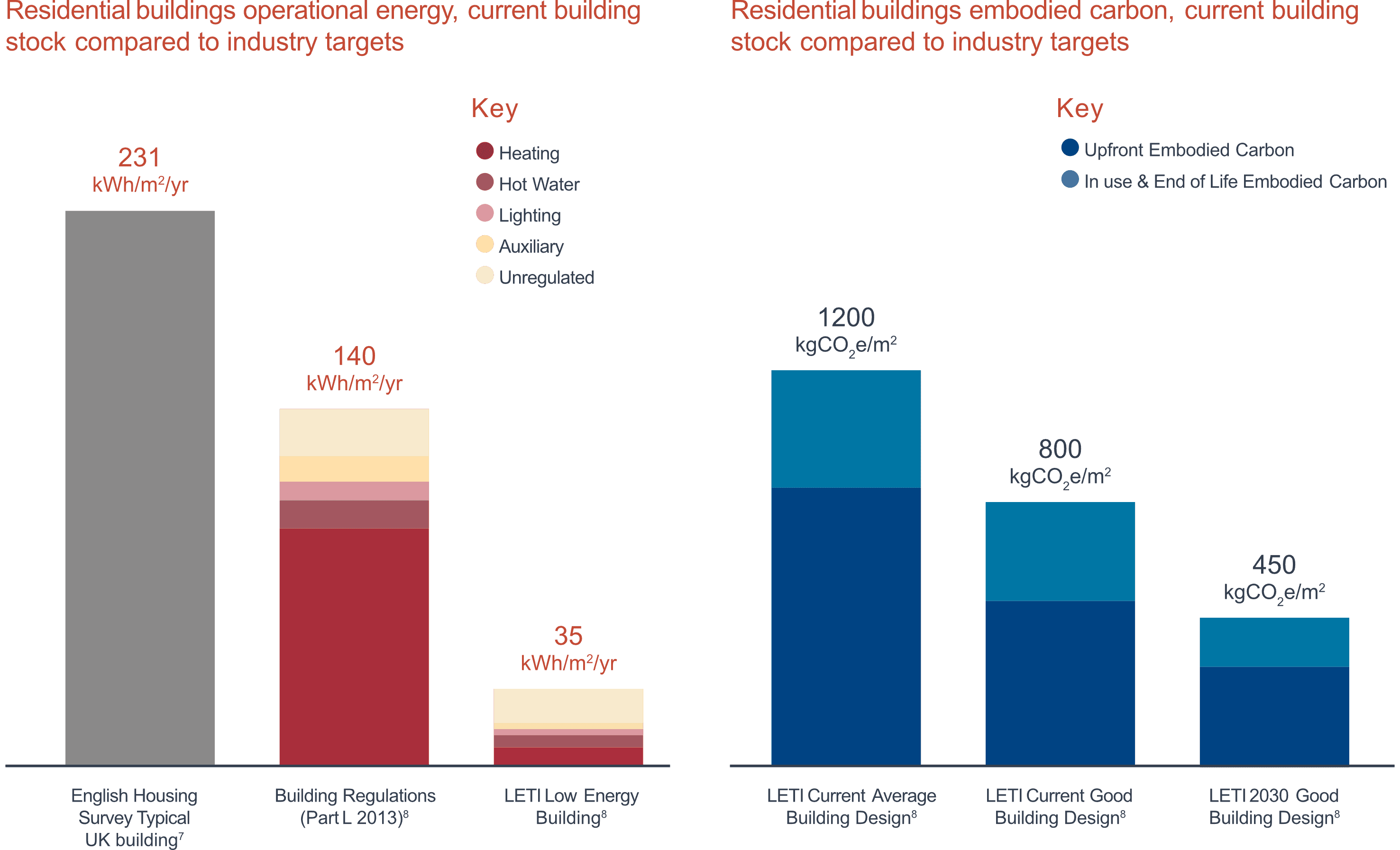
In the UK, the built environment influenced emissions contribute to roughly 42% of total carbon emissions. Inefficient construction such as poor insulation, inadequate airtightness, and thermal bridging, causes significant heat loss, increasing the energy required to maintain comfortable indoor conditions. Figures 6 and 7 showcases the current average building stock and the industry targets that need to be reached to align with 1.5°C.
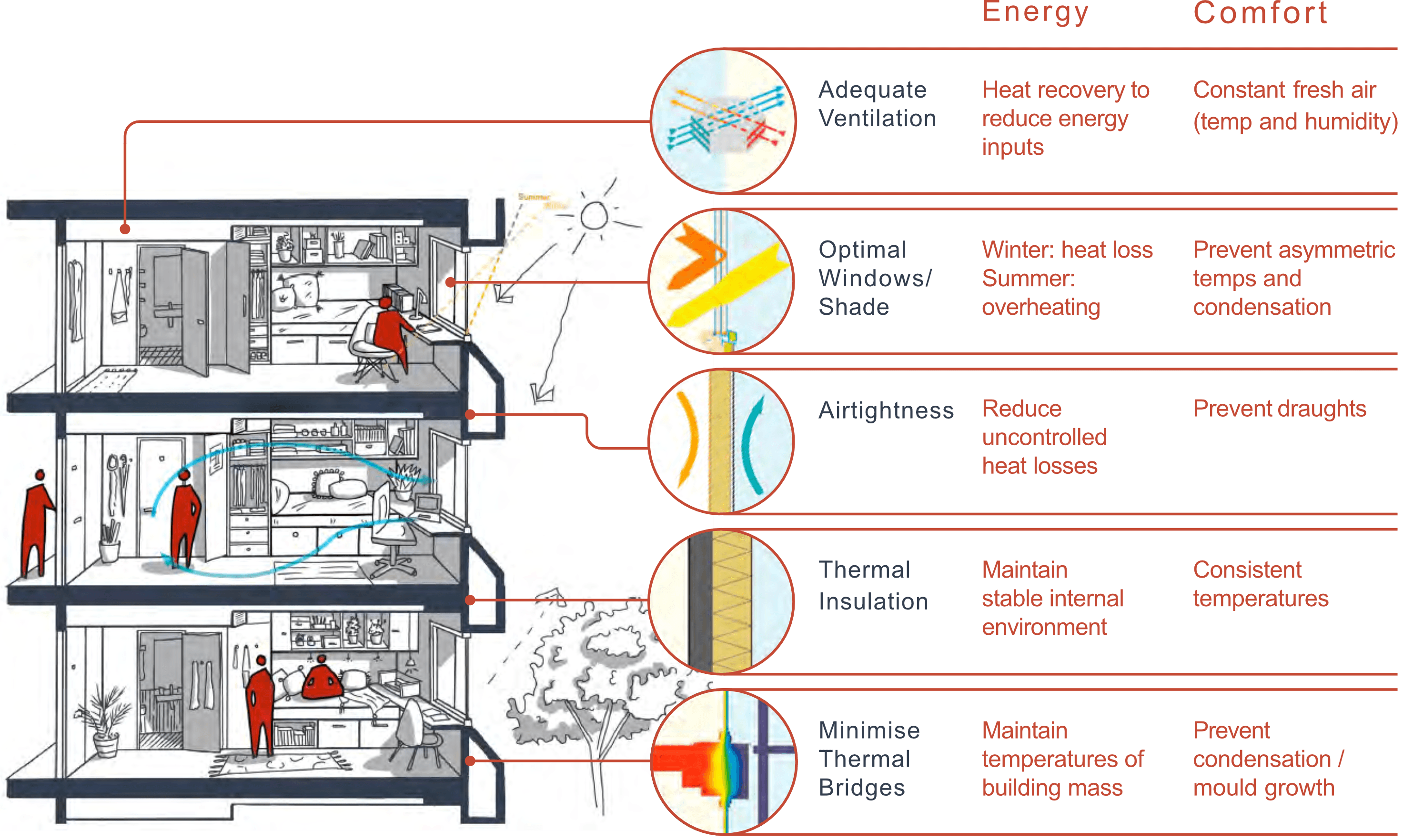
The 5 principles of Passivhaus
The Benefits
Climate Emergency
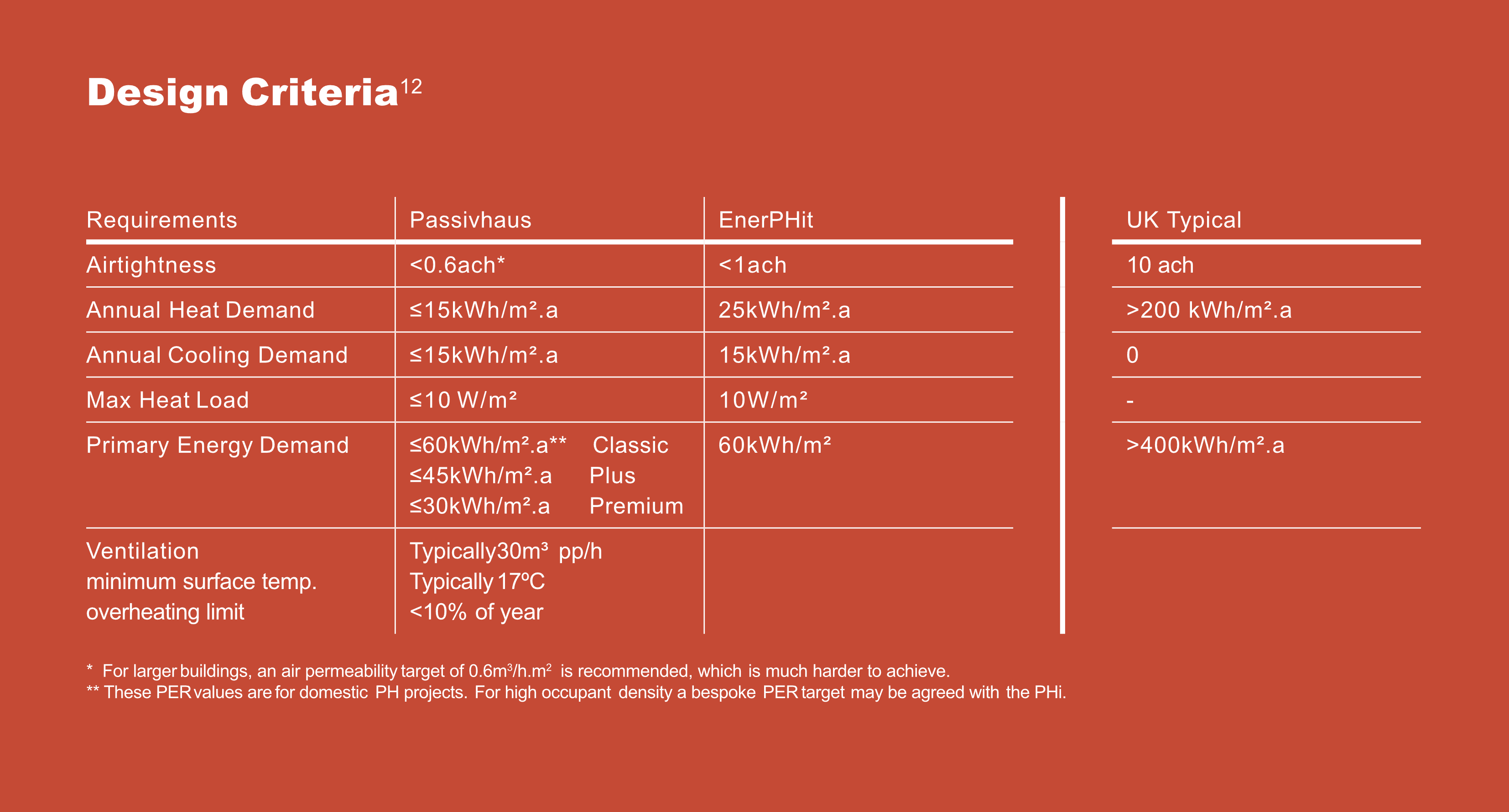
Passivhaus reduces operational energy demand by up to 90%, significantly cutting carbon emissions and supporting net-zero targets. Its focus on airtightness, insulation, and heat recovery enhances climate resilience and maximises the efficiency of renewable energy sources.
Health
By maintaining high indoor air quality through MVHR, Passivhaus minimises CO₂, dust, and pollutants while preventing cold spots, damp, and mould. Stable indoor temperatures improve comfort and protect occupants from extreme weather impacts, promoting overall well-being.
People Performance
Consistent indoor conditions with fresh air and superior insulation enhance comfort, cognitive function, and productivity. The elimination of CO₂ buildup and noise pollution creates healthier and more pleasant living and working environments.
Financial
With drastically reduced heating and cooling needs, Passivhaus lowers energy bills, increases property value, and reduces long-term maintenance costs.
High durability and efficiency make it a cost-effective solution for sustainable development.
Social
Passivhaus supports affordable housing by lowering lifetime energy costs and improving urban resilience through climate-adaptive buildings. By setting a benchmark for sustainable design, it drives industry innovation and influences policy.
Closing the performance gap
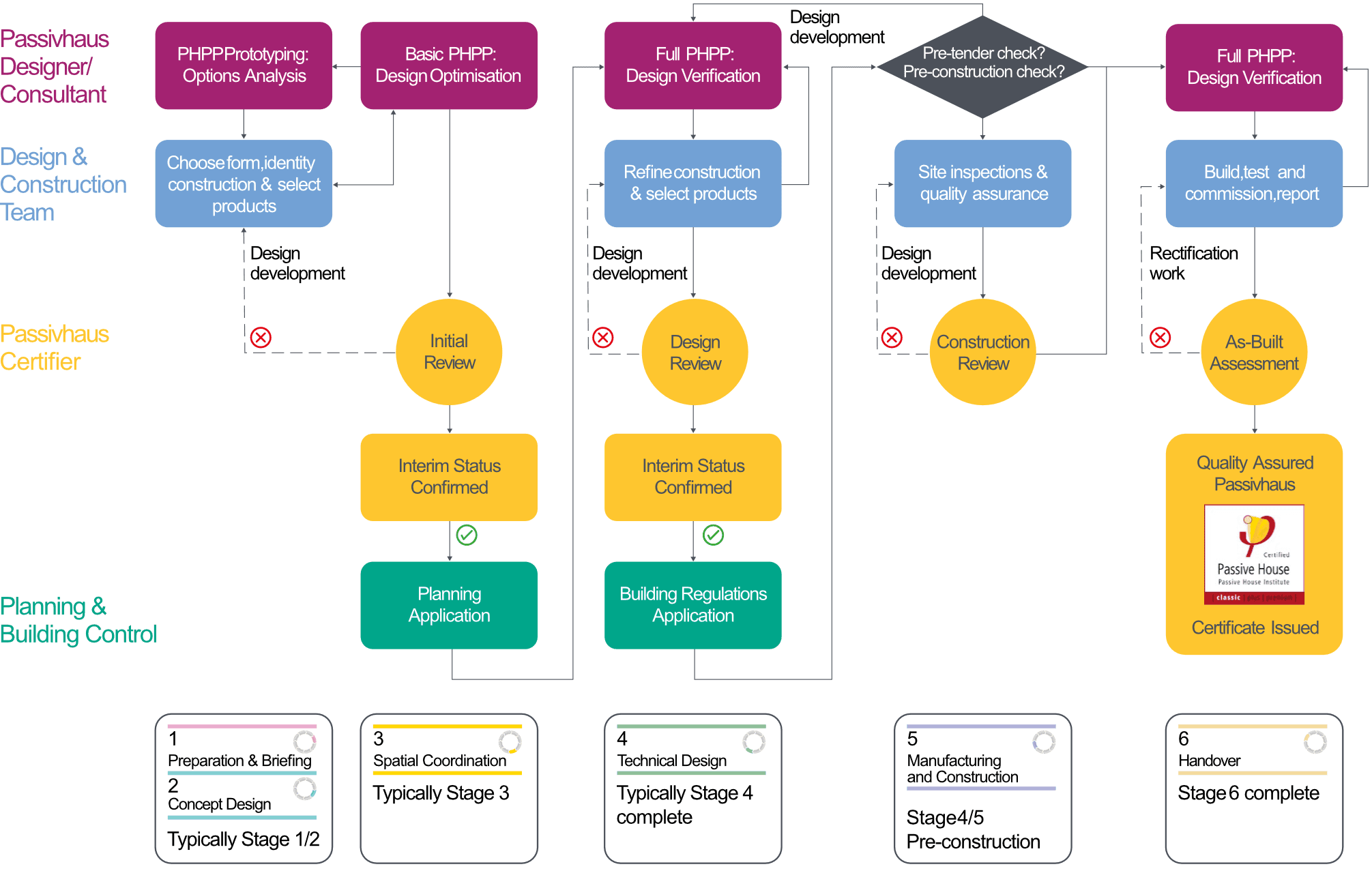
Passivhaus ensures buildings perform as designed through precise energy modeling (PHPP), high-quality construction, quality assurance processes toward certification, and third-party verification. While initial costs may be slightly higher due to better materials and workmanship, these investments eliminate performance discrepancies, prevent costly retrofits, and reduce long-term operational expenses.
Certification Process
Evidence based
Passivhaus is different from many other energy measures because it is not just a collection of good intentions, products, or sustainability claims. It is a performance-based standard built around measurable outcomes. In other words, it is not enough to say a building has better insulation, efficient plant, or renewable technology. The project has to demonstrate, through calculation, design development, testing, and verification, that the building will actually perform to a defined standard.
A lot of energy strategies in the construction industry focus on what is specified rather than what is delivered. A project might include efficient systems, thicker insulation, or low-carbon technologies on paper, but that does not automatically mean the completed building will perform as expected. Gaps in coordination, poor workmanship, changes during construction, and weak commissioning can all create a significant performance gap between design intent and real-world operation.
Passivhaus stands apart because it is built around evidence. The design is first tested through PHPP, the Passive House Planning Package, which is a detailed energy balance tool used to predict performance. But crucially, the process does not stop at design stage. The certification route requires the team to prove that the building as constructed matches the building that was modelled.
That means the standard is supported by a rigorous quality assurance process throughout design and construction. Thermal bridge calculations must be resolved properly. Windows, ventilation systems, and other components must meet defined performance requirements. Airtightness must be tested on the completed building. Ventilation systems must be commissioned correctly. The certifier reviews drawings, specifications, calculations, product data, and test results to confirm that the evidence is consistent with the performance claim.
This is what makes Passivhaus fundamentally different from more superficial energy measures. It does not rely on assumptions that the building will perform simply because certain products were included. It requires proof. You have to demonstrate that what was designed is what was built, and that what was built can meet the standard in practice.
That evidence-based approach is one of Passivhaus’s greatest strengths. It reduces the risk of underperformance, gives clients greater confidence in the quality of the outcome, and helps close the long-standing gap between predicted and actual building performance. In that sense, Passivhaus is not just an energy target. It is a discipline of design verification, construction quality, and measurable delivery.
This is whay Passivhaus is so valuable. It shifts the conversation away from aspirational sustainability and towards accountable building performance. It asks not only whether a project was intended to be efficient, but whether the completed building can prove it.